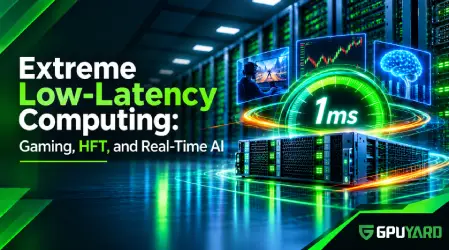
Raw throughput gets all the headlines, yet latency is what quietly breaks production systems. Think about what happens when a multiplayer server drops a single simulation tick, an algorithmic order hits the matching engine a millisecond late, or a live voice agent pauses mid-sentence. In all three cases, bandwidth isn't the problem. The delay between signal and execution is.
On paper, esports studios, quantitative trading desks, and AI infrastructure teams look like completely different worlds. Down at the metal, however, they fight the exact same physics. Virtualized cloud instances introduce noisy neighbors, hypervisor scheduling delays, and unpredictable network hops that ruin time-sensitive workloads. Getting consistent, sub-millisecond performance comes down to three things: unabstracted bare-metal infrastructure, task-specific silicon, and the shortest possible path to the network edge.
Why Averages Lie: The Problem With Tail Latency
Most infrastructure benchmarks focus on average response times, which hides the real issue. An average ping of 12ms sounds fine until a background hypervisor interrupt causes a sudden 45ms spike—what systems engineers call tail latency (p99 or p99.9).
- Silicon mismatch: Sequential tasks like game physics and order routing stall on low-clock, high-core-count enterprise chips. Parallel tasks like matrix multiplication choke without dedicated tensor hardware.
- Kernel overhead: Every time the operating system copies a network packet between kernel space and user space, you lose precious microseconds.
- Routing detours: Sending traffic through three regional transit providers instead of peering directly at a major exchange adds physical distance you can never tune away in software.
Comparing Sub-Millisecond Compute Profiles
Before provisioning hardware, it helps to map out where each workload actually spends its time budget:
| Industry Vertical | Strict Time Window | Primary Bottleneck | Recommended Architecture |
|---|---|---|---|
| Competitive Gaming | Under 7.8ms per frame (128Hz) | Single-thread CPU frequency & VM jitter | 5.0GHz+ bare-metal CPUs, local NVMe |
| Algorithmic Trading | Microsecond scale (Tick-to-Trade) | OS network stack & physical distance | High-clock CPU + GPU, DPDK, colocation |
| Real-Time AI Inference | Under 100–200ms end-to-end | Transit network hops & VRAM bandwidth | NVIDIA L4/A30/A100 + direct IXP peering |
1. Competitive Game Hosting: Why Clock Speed Beats Core Count
Modern multiplayer engines—especially Unreal Engine 5 builds running server-authoritative physics and complex NPC pathfinding—process their main simulation loop sequentially. Throwing a 64-core, 2.6GHz processor at a single match won't stop rubber-banding or fix missed hit registration.
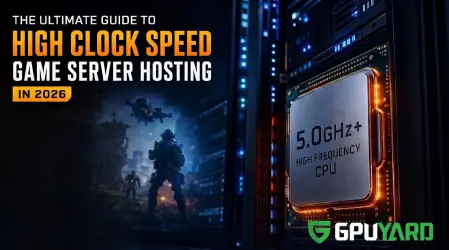
Running a true 128Hz tick rate leaves the processor just 7.8 milliseconds to calculate player inputs, collision math, and world state updates. As we broke down in our 2026 analysis of high clock speed game server hosting, sustaining 5.0GHz+ boost clocks without hypervisor interference is the only reliable way to prevent dropped ticks during peak combat.
If your engineering team is building out custom environments from scratch, our hands-on walkthrough on setting up a dedicated gaming server covers SteamCMD deployment, Linux versus Windows resource overhead, and port security.
2. High-Frequency Trading (HFT): Shaving Microseconds Off Tick-to-Trade
In quantitative finance, speed is measured by the Tick-to-Trade loop—the exact time elapsed between a market data packet arriving at your Network Interface Card (NIC) and your execution order leaving the chassis. A single millisecond of slippage can wipe out an entire day's arbitrage edge.
Today's quant stacks split the workload across two distinct compute layers. High-frequency CPU cores pinned to isolated threads handle deterministic order routing, while dedicated GPUs run live neural network inference and rapid backtesting using CUDA libraries like CuPy. You can review the full stack—from disabling garbage collection to tuning real-time Linux kernels—in our guide on reducing latency in algorithmic trading.
3. Real-Time AI Inference and Direct Network Peering
Offline model training can easily absorb a 200ms batch delay. Live, synchronous inference—such as real-time fraud scoring, interactive voice assistants, and dynamic recommendation feeds—cannot. Even an enterprise Tensor Core GPU sits idle if user requests bounce across half a dozen intermediary ISPs before reaching your rack.
Where your server physically sits matters just as much as the silicon inside it. Hosting inference nodes inside a major connectivity hub like London gives you direct access to the London Internet Exchange (LINX), linking your hardware to over 950 autonomous networks over minimal fiber hops. We examine how geographic proximity and exchange peering cut round-trip delays in our look at network latency for AI inference across the UK and Europe.
4. Bypassing the OS Kernel With DPDK and GPUDirect RDMA
Once you eliminate virtualization and optimize physical routing, the host operating system itself becomes the slowest link in the chain. Standard Linux networking relies on hardware interrupts and multiple memory copies just to move a packet from the NIC into application memory.
To reach deterministic, microsecond-level ingestion for distributed AI clusters and high-frequency data feeds, systems architects bypass the kernel completely. Pairing the Data Plane Development Kit (DPDK) with NVIDIA GPUDirect RDMA lets a ConnectX NIC write packets straight into GPU VRAM over the PCIe bus—skipping system RAM and host CPU cycles entirely. For exact NUMA alignment checks, hugepage configs, and Meson build flags, follow our engineering tutorial on kernel bypass networking with DPDK and GPUDirect RDMA.
Frequently Asked Questions
Build Without Hypervisor Overhead on GPUYard
Whether you are scaling 128Hz multiplayer clusters, colocation-grade trading nodes, or low-latency AI endpoints, GPUYard bare-metal servers give you direct access to high-frequency CPUs, NVIDIA Tensor Core GPUs, and tier-1 direct peering—with zero virtualization tax.
 Recent Topics for you