Deploying a 400-billion parameter model like Llama 4 or a 671B Mixture-of-Experts (MoE) architecture like DeepSeek exposes an immediate hardware bottleneck. Inference at this extreme scale relies on far more than raw computational force. Memory capacity and data bandwidth ultimately dictate whether your server rack operates efficiently or becomes an expensive chokepoint.
Organizations can no longer simply throw default hardware at these massive open-weight models. You need a targeted infrastructure strategy. This technical breakdown examines exactly how the NVIDIA H200 and AMD MI325X handle the precise memory and processing demands of next-generation language models, helping you avoid costly deployment mistakes.
Hardware Specifications Head-to-Head
Before diving into real-world architecture limitations, we must establish the baseline capabilities of both accelerators.
| Specification | NVIDIA H200 | AMD Instinct MI325X |
|---|---|---|
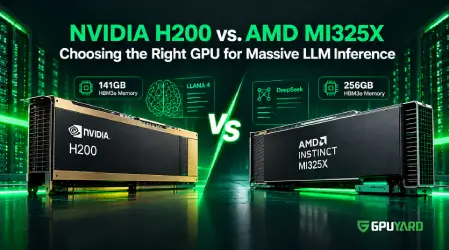
| Memory Capacity | 141 GB HBM3e | 256 GB HBM3e |
| Memory Bandwidth | 4.8 TB/s | 6.0 TB/s |
| Compute (FP8) | 1,979 TFLOPS | 2,615 TFLOPS |
| Power Draw (TDP) | 700W | 1000W |
AMD engineered the MI325X to dominate raw memory capacity. By pushing limits on High Bandwidth Memory (HBM3e) integration, they built a chip designed specifically to hoard data. NVIDIA, conversely, optimized the H200 for broader system efficiency and established architectural reliability, banking on its dominant software stack to extract maximum performance from slightly smaller hardware specs.
Surviving the VRAM Wall (Llama 4 & DeepSeek Limits)
A 400-billion parameter model requires hundreds of gigabytes just to load its weights into memory. That calculation does not even include the KV cache required to process and remember user prompts, which expands linearly with context length.
The MI325X’s massive 256GB capacity fundamentally alters cluster design for enterprise deployments. By fitting larger model shards onto a single chip, engineers drastically reduce the need for constant, latency-heavy communication across multiple GPUs (known as Tensor Parallelism). When running DeepSeek V3 or R1, the ability to store vast amounts of expert weights locally on fewer chips prevents network bottlenecks from crippling your application.
The H200’s 141GB limit forces a completely different physical reality. Hosting the exact same DeepSeek or Llama 4 instance requires linking more physical NVIDIA GPUs just to accommodate the baseline memory footprint. This forces you into complex multi-node setups faster, increasing points of failure and driving up networking complexity.
Inference Speed and Token Generation
During the decode phase of LLM inference—the exact moment the AI generates text—memory bandwidth limits token generation speed far more than the processor itself. Data must travel from VRAM to the compute cores continuously. Fast processors stall instantly if they cannot fetch data quickly enough.
AMD provides 6.0 TB/s of bandwidth against NVIDIA’s 4.8 TB/s. For a user waiting on a DeepSeek reasoning response, this hardware gap translates directly to faster text generation (Tokens Per Second). While AMD also boasts higher raw FP8 compute capabilities, large-scale inference remains almost entirely memory-bound. The MI325X feeds its compute cores faster, directly accelerating the end-user experience for large-batch inference workloads.
The Software Ecosystem: CUDA vs. ROCm
Hardware specs only matter if developers can actually utilize them. Here, CUDA remains NVIDIA’s most formidable advantage.
Tools like TensorRT-LLM ensure that when a new Llama version drops, it runs flawlessly on day one. NVIDIA provides zero friction. Enterprise teams do not have to write custom kernels or wait for community patches to deploy cutting-edge models. The ecosystem just works.
AMD has aggressively closed the gap with its ROCm platform. The framework has seen massive improvements over the last year, especially when paired with open-source inference engines like vLLM and SGLang. However, early adopters deploying brand-new models on AMD hardware often face a required debugging period. Workarounds, compiling errors, and unoptimized kernels are still occasional realities. Buyers must carefully weigh AMD's hardware superiority against NVIDIA's absolute, plug-and-play software reliability.
Power Consumption and Total Cost of Ownership (TCO)
Data center physical constraints dictate hardware limits just as much as budget. The MI325X pulls roughly 1000 watts under heavy compute loads. The H200 sits significantly lower at 700 watts, making it far easier to cool using traditional air infrastructure.
Calculating true efficiency, however, requires evaluating the entire cluster footprint. If higher VRAM allows you to host a 671B model on fewer AMD GPUs, the increased per-chip power draw often balances out at the node level. Furthermore, requiring fewer GPUs drastically reduces dependency on expensive high-speed networking switches—such as InfiniBand or ultra-high-end Ethernet setups—lowering the overall capital expenditure (CapEx) of the deployment.
Final Verdict: Which GPU Fits Your Infrastructure?
Hardware selection entirely depends on your internal engineering capabilities and specific AI roadmap.
- Choose the AMD MI325X when: You are serving the largest possible open-weight models (Llama 400B+, DeepSeek 671B MoE). It wins decisively when your priority is maximum VRAM density to reduce the total number of GPUs required per node. If your team possesses the engineering talent to handle occasional ROCm troubleshooting and performance tuning, AMD offers superior hardware economics.
- Choose the NVIDIA H200 if: You run a mixed, unpredictable workload of training, fine-tuning, and inference. It delivers guaranteed day-one software stability for every new framework release. If your data center operates under strict per-rack power or cooling limits, or if your team lacks the bandwidth to debug deployment software, NVIDIA remains the gold standard for enterprise reliability.
Scale Your Infrastructure with GPUYard
Whether you need the guaranteed reliability of NVIDIA's CUDA ecosystem or the massive memory bandwidth of AMD's latest hardware, scaling LLM inference requires the right bare-metal environment. Stop overpaying for cloud VMs and shift to predictable, flat-rate GPU servers.
 Recent Topics for you