Key Takeaways
- The Power Shift: Next-generation AI accelerators now demand up to 600W of Thermal Design Power (TDP) per card, rendering legacy server rooms obsolete.
- The ROI Killer: Inadequate cooling leads directly to thermal throttling. Your expensive silicon will automatically slow down to prevent physical damage, drastically increasing AI inference times.
- Facility Limitations: Standard commercial HVAC systems are not engineered to handle the 4.8kW to 6kW of continuous heat generated by a single 8-GPU server node.
- The Strategic Move: Migrating to dedicated GPU servers in purpose-built... in purpose-built data centers provides immediate access to liquid cooling and high-density power delivery, without the massive capital expenditure.
The New Reality of High-Density Compute
The enterprise hardware landscape has crossed a significant threshold. Organizations are rapidly scaling their Large Language Models (LLMs) and advanced AI inference workloads.
Hardware manufacturers have answered with incredibly powerful silicon. However, that power comes with an inescapable physical byproduct: extreme heat. We are now firmly in the 600W era.
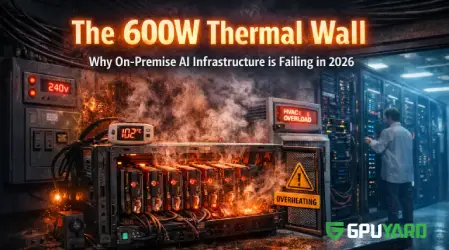
A single modern AI GPU drawing 600 watts of power introduces a critical barrier for businesses attempting to host their own hardware. We call this the thermal wall.
For IT leaders and systems architects, managing this heat is no longer just an IT issue. It is a massive facilities and infrastructure crisis.
The Physics of Heat and the Throttling Trap
To understand why on-premise AI hosting is struggling, we must look at how modern silicon protects itself.
When a processor exceeds its safe operating temperature threshold, the system initiates a self-preservation protocol known as thermal throttling. The hardware intentionally lowers its clock speed and voltage. This reduces heat output and prevents catastrophic melting.
From a financial perspective, thermal throttling is disastrous. Imagine your company invests heavily in a high-performance 8-GPU server for rapid AI inference. If you house it in a standard communications closet, the ambient temperature will spike rapidly.
The GPUs will throttle to survive. Ultimately, you will be getting the computational output of hardware that costs a fraction of what you paid. To extract 100% of your purchased processing power, the ambient thermal environment must be meticulously controlled.
Why Traditional Air Cooling is No Longer Enough
Let’s examine the mathematics of a standard AI server deployment. A typical high-performance node contains eight GPUs.
At 600W per card, the accelerators alone generate 4,800 watts (4.8kW) of continuous thermal output. Factor in dual enterprise CPUs, massive system RAM allocations, and NVMe storage arrays, and a single server can easily pull 6kW.
Traditional building HVAC (Heating, Ventilation, and Air Conditioning) systems are designed to keep humans comfortable. They are not built to cool high-density server racks.
Even older data center infrastructure, designed around 10kW-per-rack limits, will fail. A single modern AI server consumes nearly that entire thermal budget in just a few rack units (RU). Relying on standard active air cooling for 600W GPUs results in localized hot spots, fan failures, and inevitable system degradation.
How Enterprise Data Centers Solve the 600W Problem
To continuously operate next-generation AI hardware at peak capacity, infrastructure must be re-engineered from the ground up. Specialized data centers employ several sophisticated strategies:
- Direct-to-Chip (D2C) Liquid Cooling: Liquid transfers heat significantly more efficiently than air. Modern facilities utilize closed-loop liquid cooling systems with cold plates mounted directly to the GPU and CPU dies.
- Precision Airflow Management: For components still reliant on air, modern data centers use strict hot-aisle/cold-aisle containment. This prevents thermal recycling by forcing chilled air directly into server intakes.
- High-Density Power Delivery: Standard commercial power grids cannot support these deployments. A modern 8-GPU server requires specialized 3-phase, 208V/240V power circuits and advanced distribution units (PDUs).
The Smart Infrastructure Choice: Rent, Don't Build
Retrofitting an existing corporate office or legacy server room to handle 600W GPUs is a massive capital expenditure. It requires tearing up floors, upgrading the building's electrical grid for new PCIe CEM5 standards, and installing commercial-grade liquid cooling loops.
For the vast majority of businesses, the most logical strategy is to bypass the infrastructure upgrades entirely.
By utilizing GPUYard, organizations can instantly access dedicated GPU servers. These servers are already racked, networked, and cooled in state-of-the-art facilities.
This approach shifts the burden of thermal management and power delivery entirely to infrastructure specialists. You retain full root access and control over your compute environment, completely risk-free.
Conclusion
As AI workloads become more demanding, the hardware required to run them will continue to push the boundaries of physics. The 600W thermal wall proves that software innovation is ultimately bound by hardware infrastructure.
Businesses that pivot toward purpose-built hosted solutions will maintain maximum performance, optimize their ROI, and leave the thermal engineering to the experts.
Frequently Asked Questions (FAQ)
Ready to bypass the thermal bottleneck? 🚀
Maximize your AI performance without the infrastructure headaches.
Would you like to explore GPUYard’s high-density Dedicated GPU Servers today?
 Recent Topics for you