Key Takeaways (TL;DR)
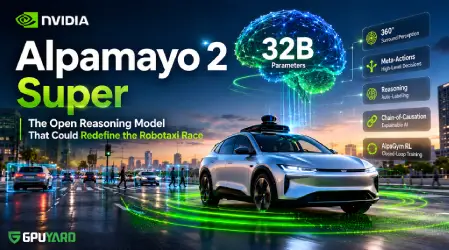
- 32B parameters, fully open: Alpamayo 2 Super triples the scale of previous Alpamayo models (10B), with 360° surround perception, Meta-Action outputs, and improved chain-of-causation reasoning — all available on GitHub and Hugging Face.
- Annotation cycles slashed: Reasoning auto-labeling compresses data pipeline timelines from months to days, fundamentally changing the economics of AV dataset development.
- Closed-loop training is now accessible: The new AlpaGym RL framework brings reinforcement learning for AV systems to any developer, not just teams with massive proprietary simulation infrastructure.
- ~400,000 downloads and growing: The Alpamayo platform has already been downloaded close to 400,000 times since its original launch, signalling serious developer traction in the open-source AV space.
For years, the autonomous vehicle industry has operated on a simple premise: the more proprietary your AI stack, the bigger your competitive moat. NVIDIA just challenged that assumption head-on.
With the launch of Alpamayo 2 Super — a 32-billion-parameter open reasoning VLA model — NVIDIA is betting that an open-source ecosystem will accelerate Level 4 autonomy faster than any closed-loop approach ever could. Announced at NVIDIA GTC Taipei 2026, this isn't just a model release. It's a complete rethinking of how the global robotaxi industry should build, train, and validate autonomous driving AI.
Whether you're an AV developer evaluating your next foundation model, a researcher studying open-source robotaxi AI, or an infrastructure engineer planning training compute — this is the release that changes your roadmap.
What Exactly Is NVIDIA Alpamayo 2 Super?
Alpamayo 2 Super is NVIDIA's most capable open driving foundation model to date. It is a vision language action (VLA) model — meaning it takes visual inputs from cameras, processes them through language model-style reasoning, and outputs both driving actions and explainable reasoning traces.
Unlike earlier generations of end-to-end AV models that primarily handled trajectory prediction, Alpamayo 2 Super introduces multitask capabilities: reasoning, auto-labeling, scene understanding, model critiquing, and knowledge distillation into smaller deployment-ready models.
Think of it as a teacher model. Its job isn't to run inside the vehicle on day one. Its job is to make every downstream model significantly smarter — and to do that at an open, accessible scale that no single AV team would build alone.
The Five Technical Pillars of Alpamayo 2 Super
Let's go beyond the launch announcement and examine what actually changed under the hood between Alpamayo 1.x Nano (10B parameters) and this new release.
1. 3× Parameter Scale
Built on NVIDIA Cosmos world foundation models, the jump from 10 billion to 32 billion parameters delivers meaningfully better 3D spatial understanding and trajectory prediction — particularly in long-tail scenarios where smaller models historically struggle. More parameters means the model can represent more complex relationships between visual context, driving history, and decision logic.
2. Full-Surround 360° Perception
Previous Alpamayo models were front-focused in their camera coverage. Alpamayo 2 Super expands to full-surround situational awareness — front, side, and rear views simultaneously. This is not a cosmetic upgrade. Safe lane changes, intersection crossings, and merge maneuvers all require complete spatial awareness that a front-only model structurally cannot provide.
3. Meta-Action Outputs
Alpamayo 2 Super introduces a new output type called Meta-Actions — macro driving decisions such as yield, lane change, and stop. This bridges the critical gap between raw trajectory prediction and high-level planning. Downstream planners receive a richer signal: not just where the vehicle should move, but why and at what level of decision hierarchy.
4. Reasoning Auto-Labeling with 2D Grounding
This is arguably the most operationally significant advancement in the release. The 32B foundation model can now generate high-quality reasoning labels automatically, compressing annotation cycles from months to days. For AV teams that have experienced the brutal economics of manual labeling at scale, this is a fundamental shift in what's buildable with a given budget and timeline.
5. Improved Chain-of-Causation (CoC) Traces
Chain-of-causation traces document the causal reasoning chain behind every driving decision the model makes. Alpamayo 2 Super shows meaningfully improved CoC quality in complex, rare scenarios — the exact situations where traditional imitation-learning AV stacks are most likely to produce dangerous failures. Better CoC traces also mean better interpretability for safety engineers and regulators.
AlpaGym: Why Closed-Loop Training Changes Everything
Releasing a bigger model is step one. Training it to actually drive safely under real-world conditions is step two. That's where NVIDIA AlpaGym comes in — an open-source, high-throughput reinforcement learning framework designed specifically for AV closed-loop training.
The distinction between open-loop and closed-loop training is fundamental and worth understanding precisely.
Open-loop evaluation scores a model's predictions against pre-recorded data. The model generates a single round of actions, those actions are compared to ground truth, and a score is produced. No consequences. No compounding effects. No feedback from the environment.
Closed-loop training is different in every meaningful way. AlpaGym runs the model through continuous decision and observation cycles inside NVIDIA AlpaSim, where every braking, steering, and navigation choice affects the simulated environment. The model experiences the downstream effects of its own decisions — including the compounding errors and cascade failures that static datasets completely miss.
This is how models learn to recover from their own mistakes before they ever touch a real road.
AlpaGym is built on the AlpaSim microservice simulation stack and NVIDIA Omniverse NuRec. Combined with the Physical AI AV Dataset, it provides a continuous path from open-loop pretraining to closed-loop refinement — a complete training pipeline that was previously only available to the largest, best-resourced AV programs in the world.
NVIDIA is also releasing the CoC Auto-Labeling Pipeline as open source on GitHub. This pipeline automatically generates decision-grounded and causally linked CoC labels from raw driving clips with no human annotation required.
OmniDreams and Neural Reconstruction: Simulating What the Road Doesn't Offer
Even a 32B model trained with closed-loop RL has one hard constraint: you can only train on scenarios you can generate. Two new tools announced alongside Alpamayo 2 Super directly address the simulation coverage problem.
NVIDIA OmniDreams
OmniDreams is a generative world model for photorealistic, closed-loop AV scenario generation. Its core purpose is enabling developers to synthesize rare and long-tail driving scenarios at scale — the 1-in-a-million edge cases that no real-world fleet could capture in sufficient training volume within a reasonable timeframe.
Think of a child running into traffic at night in heavy rain on a poorly lit residential street. A real-world fleet might encounter this scenario once in millions of miles. OmniDreams can generate hundreds of variations of it for training purposes, with photorealistic rendering accurate enough to serve as meaningful training signal.
Neural Reconstruction via NVIDIA Omniverse NuRec
The Neural Reconstruction skill, powered by Omniverse NuRec, solves a different but equally important problem. It converts real-world fleet driving scenarios into photorealistic 3D scenes — and then adapts those scenes across different vehicle sensor configurations.
This means a dataset collected with one camera rig can be repurposed to train models for vehicles with entirely different sensor setups. The economic implication is significant: AV teams no longer need to recollect and re-label data every time their hardware configuration changes.
Alpamayo 2 Super vs. Closed-Source AV Stacks: The Honest Assessment
The AV industry currently operates across two fundamentally different development philosophies. Understanding where Alpamayo 2 Super sits — and what it trades off — matters for any team making infrastructure decisions.
NVIDIA Alpamayo 2 Super (Open):
- 32B parameter open VLA model with public weights
- Open-source AlpaGym RL framework
- Post-training scripts for custom datasets and driving policies
- CoC auto-labeling pipeline on GitHub
- Designed for distillation to DRIVE AGX Thor in-vehicle compute
- Close to 400,000 downloads; actively growing third-party ecosystem
Closed Proprietary AV Stacks:
- Full in-house data and model control; no external dependencies
- Tightly integrated hardware and software optimization
- No public weights, training code, or reasoning traces
- High barrier to third-party integration and ecosystem collaboration
- Limited interpretability for regulatory validation
- Requires rebuilding the entire infrastructure stack from scratch for each new entrant
The open-source approach carries one structural advantage that closed stacks structurally cannot replicate: interpretability at scale. Alpamayo's CoC traces — explicit causal reasoning chains behind each driving decision — give safety engineers and regulators a practical mechanism for auditing model behavior. As global regulators increasingly move toward requiring explainable AI for Level 4 certification, this is a feature that proprietary black-box systems will struggle to provide.
Autonomous Vehicle Cybersecurity: What Open Weights Mean in Practice
Open-source AV models introduce a cybersecurity dimension that deserves direct treatment, particularly as Alpamayo 2 Super is designed for real-world deployment infrastructure.
The upside of transparency: Public weights enable independent security audits, adversarial testing by the research community, and red-teaming at a scale that no single internal security team could achieve. Vulnerabilities get found faster when more qualified eyes can examine the system.
The surface area to manage: Public availability also means adversarial researchers can probe for behavioral weaknesses — including adversarial patch attacks on road sign perception, out-of-distribution input exploitation, and model inversion attempts. None of these are unique to Alpamayo, but they require deliberate hardening at the inference pipeline level.
Responsible deployment of Alpamayo 2 Super in production AV systems will require input sanitization layers, runtime behavioral monitoring, hardware-level security on DRIVE AGX Thor, and regular model validation cycles as the threat landscape evolves. The open foundation model does not substitute for a secure deployment architecture.
The Hardware Reality: What Infrastructure Does Training Actually Require?
This is the question most developer-focused coverage glosses over. Let's be specific.
Alpamayo 2 Super is a 32-billion-parameter teacher model. It is not designed to run in the vehicle — it runs in the data center during training and distillation, then transfers learned behavior to compact student models that run on NVIDIA DRIVE AGX Thor inside the vehicle.
For AV development teams, this means the compute bottleneck sits in training infrastructure, not in the vehicle. Specifically:
- Fine-tuning and post-training on custom driving datasets requires multi-GPU nodes with large aggregate GPU memory. At 32B parameters in bf16, the model weights alone occupy roughly 64GB — before optimizer states, activations, and batch data.
- AlpaGym closed-loop RL is a throughput-intensive workload. Continuous simulation loops with physics rendering and model inference running in parallel demand high-bandwidth GPU interconnects and large-scale parallelism.
- OmniDreams photorealistic scenario generation and NuRec neural reconstruction are compute-intensive batch workloads that benefit significantly from dedicated GPU infrastructure with high memory bandwidth.
Teams that underestimate their GPU infrastructure requirements will find that training cycle time — not model architecture — becomes their primary competitive constraint. The model is available. The infrastructure to exploit it is where the real investment decision lies.
Why This Matters Beyond Robotaxis
Alpamayo 2 Super signals a structural shift in how physical AI systems are engineered — from imitation learning on static historical datasets to reasoning-based models trained in closed-loop simulation. This architecture isn't limited to automotive.
The same framework — open reasoning foundation model + generative simulation + closed-loop RL + auto-labeling — applies to any embodied AI system that needs to handle rare, unpredictable real-world scenarios. Logistics robotics, industrial automation, drone navigation, and warehouse systems all face the same long-tail problem that Alpamayo's stack is designed to solve.
For AI infrastructure developers and platform teams, the more important signal may be the economic one. The combination of a 32B teacher model, automated labeling, and open-source RL training tools effectively democratizes AV development infrastructure that previously only the largest OEMs and robotaxi operators could build. Smaller players can now compete on model adaptation quality and domain-specific dataset curation rather than raw foundation model investment.
The playing field didn't just level — it shifted entirely.
Conclusion
NVIDIA Alpamayo 2 Super is a calculated bet that the autonomous vehicle industry develops faster through open collaboration than through proprietary competition — at least at the foundation model layer.
By releasing a 32B reasoning VLA model alongside open-source RL training tools, photorealistic simulation frameworks, and automated labeling pipelines, NVIDIA has handed AV developers an infrastructure stack that would have taken years and hundreds of millions of dollars to build independently. The close to 400,000 download trajectory since the original Alpamayo launch suggests developers agree.
The real question isn't whether the model is technically impressive — it clearly is. The question is whether the open ecosystem accumulates enough diverse driving data, scenario coverage, and real-world validation speed to outpace proprietary systems built on fleet scale.
For AI infrastructure teams, the strategic takeaway is clear: Alpamayo 2 Super shifts the competitive differentiator from "who built the foundation model" to "who can train, fine-tune, and validate it fastest on the most relevant data." That is a compute infrastructure problem at its core. The teams with purpose-built GPU training infrastructure will run more experiments, close more training cycles, and reach production-quality models faster than those constrained by shared or underpowered compute.
Train Smarter. Scale Faster. GPUYard Has the Infrastructure.
Running AlpaGym closed-loop reinforcement learning, fine-tuning 32B parameter VLA models, or scaling OmniDreams scenario generation requires serious dedicated GPU compute — not shared cloud instances with variable performance and unpredictable availability.
GPUYard provides high-performance dedicated GPU servers — H100, H200, and multi-GPU configurations — purpose-built for large-scale AI training and inference workloads. No shared resources. No throttling. Full bare-metal performance from day one.
If Alpamayo 2 Super is your foundation model, GPUYard is your foundation infrastructure.
Frequently Asked Questions (FAQ): NVIDIA Alpamayo 2 Super
Ready to scale your AI workloads without the hyperscale price tag?
Explore GPUYard’s high-performance Dedicated GPU Servers and deploy your bare-metal H100, H200, or multi-GPU environments today.
 Recent Topics for you