If you are an MLOps engineer, CTO, or AI infrastructure lead in 2026, you already know that the landscape of large language model (LLM) deployment has fundamentally shifted. The days of simply throwing the most expensive hardware at a model and hoping for the best are over. Today, scaling AI is an exercise in unit economics.
The question we hear constantly at GPUYard is no longer just, "Which GPU is fastest?" but rather, "Which GPU gives me the lowest cost-per-token without breaching my latency SLAs?"
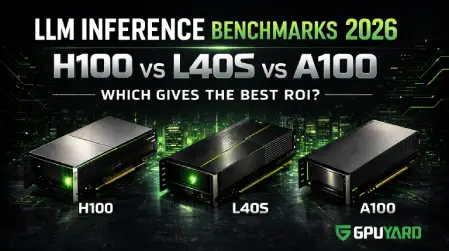
In this deep dive, we are going back to the data. We will compare the NVIDIA H100, the versatile L40S, and the legacy A100, breaking down real-world LLM inference benchmarks and pricing frameworks to help you maximize your Return on Investment (ROI) in cloud GPU hosting.
The 2026 Contenders: Architecture & Bottlenecks
Before we look at the numbers, let’s talk about how these GPUs are fundamentally built. When running LLM inference, your primary bottleneck is rarely raw compute (FLOPS); it is almost always memory bandwidth. The speed at which you can move model weights from the VRAM to the Tensor Cores dictates your token generation speed.
- NVIDIA H100 (Hopper): The Premium Bullet Train. Featuring 80GB of HBM3 memory pushing a massive 3.35 TB/s of bandwidth, the H100 also introduces native FP8 precision via its Transformer Engine. It is built specifically to accelerate the math that powers LLMs.
- NVIDIA L40S (Ada Lovelace): The Versatile Hybrid. With 48GB of GDDR6 memory (864 GB/s bandwidth), the L40S doesn't have the brute force of Hopper, but its aggressive price-to-performance ratio and 4th-gen Tensor Cores make it a dark horse for smaller models and multimodal AI.
- NVIDIA A100 (Ampere): The Legacy Cargo Ship. The workhorse of the first generative AI wave. With up to 80GB of HBM2e (2 TB/s bandwidth), it lacks FP8 support but remains highly relevant for batch processing and offline workloads where extreme low latency isn't required.
LLM Inference Benchmarks: Throughput & Latency
To get an accurate picture, we have to look at vLLM throughput metrics across different parameter sizes. We are measuring Tokens Per Second (tok/s) at optimized batch sizes using TensorRT-LLM.
1. Small to Medium Models (7B – 14B Parameters)
For models like Llama 3 (8B) or Mistral, the hardware gap narrows.
- H100: Blistering speeds, easily clearing 9,000+ tok/s at high concurrency.
- L40S: Surprisingly resilient. It can sustain ~1,500+ tok/s. Because the model weights fit comfortably inside its 48GB VRAM, the GDDR6 memory bandwidth isn't fully choked.
- A100: Pushes respectable numbers (~1,200 tok/s), but its older 3rd-gen Tensor cores mean it works harder to keep up with the L40S.
2. Large Models (70B+ Parameters)
This is where architectural differences become financially critical.
- H100: The undisputed king. For a Llama 2/3 70B model, an optimized H100 setup can push throughputs over 100x higher than an unoptimized A100. Furthermore, its 4th-gen NVLink (900 GB/s) allows multiple GPUs to act as a single brain, drastically reducing inter-GPU communication lag for models that exceed 80GB.
- A100: Usable, but latency suffers. Time-to-First-Token (TTFT) increases notably.
- L40S: Struggles here. It lacks NVLink (relying on PCIe Gen4), making multi-GPU scaling for massive models a major bottleneck.
The ROI Equation: Hourly Price vs. Cost-Per-Token
The biggest mistake enterprise teams make is looking exclusively at the hourly rental rate. In 2026, GPU cloud hosting pricing has stabilized, but the efficiency of that spend varies wildly.
- Average Hourly Rates (On-Demand): H100 (~$2.50 - $4.00/hr) | A100 (~$0.80 - $1.50/hr) | L40S (~$0.50 - $0.90/hr).
If an A100 is three times cheaper per hour than an H100, you should use the A100, right? Wrong. If you are running a real-time chat application with a 70B model, the H100 processes requests up to 3x to 5x faster than the A100 (and radically faster when utilizing FP8 quantization). Because you are generating tokens so much faster, your Cost per 1 Million Tokens is actually lower on the H100.
The GPUYard Decision Framework
To maximize your budget, deploy based on your workload's specific profile:
Choose the NVIDIA H100 if:
- You are serving models larger than 30B parameters.
- You have strict real-time latency SLAs (e.g., interactive customer service bots where users are waiting for the cursor to blink).
- You need multi-GPU scaling via NVLink.
Choose the NVIDIA L40S if:
- You are running smaller LLMs (<13B), RAG adapters, or daily fine-tunes.
- Your pipeline includes Vision-Language models or image/video generation (where the Ada Lovelace architecture excels).
- You want the absolute best cost-per-token for containerized, small-scale inference.
Choose the NVIDIA A100 if:
- You are running massive batch inference jobs (offline document processing, sentiment analysis) where throughput matters, but TTFT latency does not.
- You have legacy codebases heavily optimized for Ampere that you aren't ready to migrate.
Real-World FAQ from AI Professionals (2026)
Straight answers to the most common hardware bottlenecks faced by MLOps teams today.
Optimize Your Infrastructure with GPUYard 🚀
Navigating the complexities of tensor cores, memory bandwidth, and vLLM throughput metrics doesn't have to be a guessing game. The hardware you choose directly impacts your margins. At GPUYard, we specialize in matching your exact inference pipeline to the most cost-efficient, high-performance GPU clusters available.
Would you like us to help analyze your current model's memory footprint to see exactly how much you could save by migrating workloads?
 Recent Topics for you