Getting an open-weight model like Llama 4 70B+ or DeepSeek running in a staging environment is relatively easy. Keeping it responsive and economical in production? That is a much harder problem.
I see this constantly. A pilot project runs perfectly on a standard cloud GPU instance with a handful of internal users. Then, production traffic hits. Context lengths vary. Agentic workflows trigger background loops. Suddenly, latency triples. The GPUs run out of memory. And that "pay-as-you-go" cloud bill that looked so affordable in testing explodes to $46,000 a month.
The Trilemma
Scaling LLM inference is a constant, unforgiving battle against three factors:
- Cost: Keeping the cost-per-token lower than closed-source APIs.
- Latency: Hitting a Time-to-First-Token (TTFT) of <500ms (or <200ms for voice).
- Throughput: Processing enough concurrent users to make the hardware ROI positive.
You cannot improve one without impacting the others. This is not a textbook explanation of neural networks. This is your practical, 2026 deployment playbook.
The Physics of Inference & The "VRAM Wall"
Most infrastructure teams size their GPU requirements by looking at the model's parameter count, buying enough VRAM to hold the weights, and assuming the rest is just "headroom." That assumption is why deployments crash on day one.
Why Compute (FLOPs) is a Lie
When evaluating GPUs, marketing sheets push TFLOPS (Tera Floating-Point Operations Per Second). For inference, looking only at FLOPs is a trap.
LLM generation is autoregressive. During the decode phase, the model generates one token at a time. To do this, it must read the entire model weight and the stored context history from the GPU's memory into the compute cores for every single token.
You are not compute-bound. You are memory-bandwidth-bound.
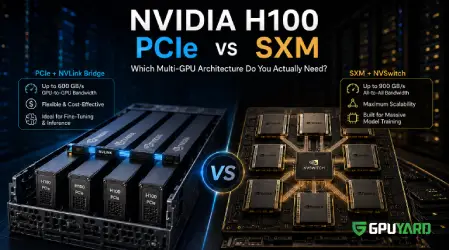
This is exactly why the NVIDIA H100 SXM5 dominates production inference. It is not just about the compute cores. It is about the staggering 3.35 TB/s of HBM3 memory bandwidth. Put the same model on a GPU with high compute but low memory bandwidth, and your inter-token latency will drag.
The Hidden "Context Tax" & KV Cache
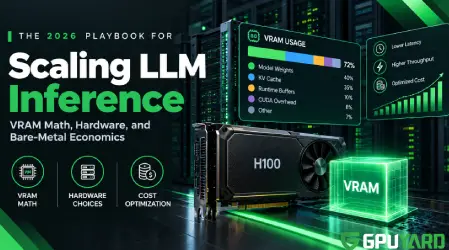
Model weights are static. The KV (Key-Value) Cache is dynamic, and it is the silent killer of AI deployments. To avoid recomputing the entire conversation history for every follow-up question, the LLM stores the mathematical representations of past tokens in VRAM.
This cache grows linearly with batch size and context length. Let's look at the actual math for a Llama 70B class model using Grouped-Query Attention (GQA), running natively in FP16 precision:
If one user sends a prompt that consumes a 32K context window, they instantly lock down 10.74 GB of VRAM.
If five users hit your endpoint simultaneously with long-context queries, you lose ~55 GB of VRAM. Run this on an 80GB GPU, and your server will throw an Out-Of-Memory (OOM) error before it even starts generating meaningful throughput.
The Fix: You cannot brute-force this by buying more GPUs. You must optimize at the software layer using PagedAttention (vLLM) and Quantization (FP8/INT4). Read our full guide on Optimizing KV Cache to stop this memory bleed.
The Economics of AI Infrastructure
Once inference moves beyond experimentation, infrastructure economics dictate whether your startup survives. There are three common paths: buying hardware, renting cloud VMs, and leasing bare-metal servers.
Let's look at the brutal realities of each.
| Infrastructure Model | Upfront Capital (CapEx) | Monthly Operating Cost (OpEx) | Scaling Speed | Best For |
|---|---|---|---|---|
| Buy Hardware | $250k - $400k (per 8x H100 node) | $5k - $20k (Power/Colo) | Months (Procurement) | Massive 24/7 internal training runs. |
| Cloud VMs (AWS/GCP) | $0 | Extremely High (Pay-as-you-go + Egress) | Minutes | Short-lived, unpredictable burst experiments. |
| Bare-Metal Servers | $0 | Fixed, Predictable Flat Rate | Hours | Sustained production inference endpoints. |
The CapEx Trap of Buying Hardware
On a spreadsheet, buying looks cheaper over a 36-month horizon. In reality, it locks up half a million dollars in rapidly depreciating metal. Furthermore, an 8-GPU H100 cluster pulls roughly 10 kilowatts (kW) of power. You will pay thousands monthly just to keep it from melting in a colocation facility.
The Cloud "Pay-As-You-Go" Illusion
Public clouds sell you on flexibility. This works perfectly for web traffic. It fails completely for stateful, memory-bound LLM inference. When you deploy autonomous agents that run multi-turn reasoning loops, your compute stays pinned. Add in the hidden egress fees and hypervisor latency spikes, and your bill multiplies exponentially.
The Bare-Metal Advantage
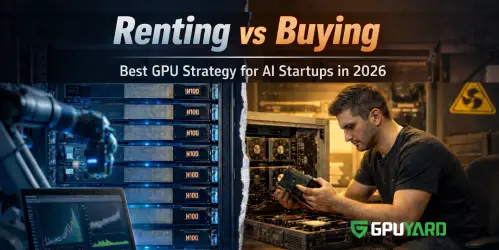
This leaves the hybrid approach that serious infrastructure teams use today: renting dedicated, bare-metal servers. You pay a predictable flat monthly rate. No egress extortion. No hypervisor latency. 100% of the raw PCIe bandwidth. You shift your risk entirely from CapEx to OpEx. Want the full financial breakdown? See our guide on Renting vs. Buying GPUs in 2026.
The 2026 Hardware Decision Matrix
You don't buy a Ferrari to haul gravel. Similarly, you shouldn't provision an H100 for every single AI workload. Here is the exact hardware matrix we use to map workloads to silicon.
NVIDIA H100 SXM: The Heavyweight King
This is the undisputed champion of strict SLA environments. If your product relies on voice-to-voice AI or synchronous chat where Time-to-First-Token (TTFT) must stay under 300ms, the H100 is mandatory. Yes, it costs more per hour. But its massive throughput often results in the lowest cost-per-token at scale.
NVIDIA L40S Clusters: The Hidden ROI Gem
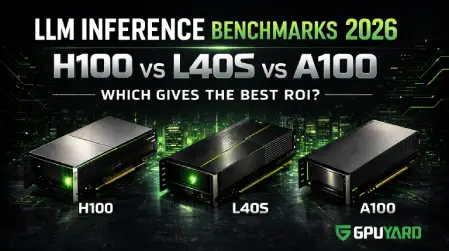
Not every workload is a 70B monolithic model. If you are serving 7B to 30B models for RAG pipelines, internal data processing, or batch generation, look at the L40S. You can often cluster 4 to 8 L40S GPUs for the price of a single H100 node, offering incredible parallel throughput for generative tasks. See our H100 vs L40S ROI benchmarks.
RTX 6000 Ada & A100: The Budget Workhorses
The RTX 6000 Ada Generation packs 48GB of VRAM, making it the ultimate bridge card to hold large models entirely in memory without paying the data center premium. Meanwhile, the A100 80GB remains the go-to choice for workloads where throughput isn't the primary bottleneck, but you desperately need that 80GB memory pool for heavy context windows.
Looking Ahead: The Next-Gen Battlefield
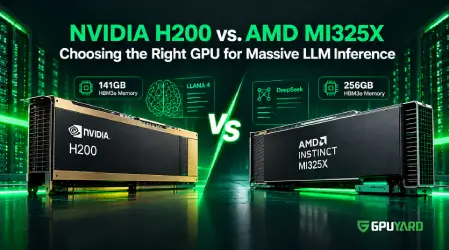
As models scale, the hardware landscape is shifting rapidly. If you are evaluating the absolute bleeding-edge GPUs for DeepSeek or Llama 4, the conversation usually comes down to the newest silicon. We did a deep dive into the hype vs. reality—check out our full comparison on NVIDIA H200 vs AMD MI325X for DeepSeek & Llama 4 Inference to see why optimized H100 and A100 bare-metal setups still offer the best guaranteed ROI right now.
The Serving Engine Wars
Having the right bare-metal hardware is only half the equation. Deploy a Llama 3 model using raw PyTorch, and you are leaving 80% of your GPU’s performance on the table. You need a dedicated serving engine.
- vLLM & PagedAttention: Treats GPU VRAM like OS virtual memory. It splits the KV cache into fixed-size, non-contiguous blocks, dropping memory waste from 80% down to under 4%.
- SGLang & RadixAttention (The Agentic Choice): If you run autonomous agents, you are sending the same system prompt repeatedly. SGLang stores these in a radix tree and reuses the prefix instantly. Time-to-First-Token drops to near zero for warm requests. Learn how to deploy SGLang.
- TensorRT-LLM: The ultimate NVIDIA optimization. It leverages in-flight batching and runs natively in FP8 precision for the absolute lowest latency on Hopper and Ada architectures. See our TensorRT-LLM guide.
Deploying Multi-Agent Systems in Production: When you run autonomous agent frameworks like Microsoft AutoGen, your agents constantly exchange messages, causing your KV Cache to grow exponentially with every turn. Public cloud APIs will throttle these loops, and consumer GPUs will crash. To see exactly how to solve this practically, check out our step-by-step guide on How to Deploy Multi-Agent Systems using AutoGen on Dedicated A100 Servers.
Advanced Architecture: Prefill-Decode Disaggregation
At enterprise scale, even the best serving engines hit a wall if you run monolithic inference.
Standard setups run every request through a single GPU pool. The problem? Prefill is compute-bound, while Decode is memory-bandwidth-bound. When you run both on the same GPU, they bottleneck each other.
The 2026 solution is Prefill-Decode Disaggregation. You physically split the workloads. You route all compute-heavy Prefill tasks to a pool of NVIDIA H100s. Once processed, the H100 streams the KV cache over a high-speed RDMA network to a pool of memory-heavy A100s, which take over the decode phase. Each GPU does exactly what it is built to do.
Conclusion: Build Your Product, Not a Data Center
Scaling LLM inference is no longer an academic exercise; it is a financial one. Surviving the VRAM wall requires combining the right software (FP8, vLLM/SGLang, disaggregation) with the right infrastructure economics. Relying on the cloud's pay-as-you-go model for steady-state AI traffic is a fast track to burning your runway. To win in 2026, you need maximum hardware performance tied to a predictable, flat-rate monthly cost.
 Recent Topics for you