Canada's AI research output has grown fast enough that "where do I train this model" is no longer just a hardware question. Toronto's Vector Institute, Montreal's Mila, and Edmonton's Amii have made the country one of the more concentrated AI research hubs in North America.
That growth is pulling startups, research labs, and enterprise teams into a decision they didn't expect to make: how to build AI infrastructure that's both cost-effective enough to scale and compliant enough to survive a privacy audit.
Most guides treat those as two separate problems. They aren't. If your data includes personal information, customer records, health data, behavioral logs, anything tied to an identifiable person, your choice of GPU and your choice of jurisdiction are the exact same decision.
This guide walks through both sides: how to choose the right GPU hardware without overspending, and what PIPEDA and Quebec's Law 25 require when that hardware is processing personal data.
Quick Summary: Key Takeaways
- Right-sizing your GPU saves thousands: You don't always need a massive H100 or A100. For AI inference, fine-tuning, and video analytics, enterprise cards like the NVIDIA L4, Tesla T4, and P4 offer the best price-to-performance ratio.
- Consumer GPUs belong at home: The RTX 4090 might look great on paper, but it lacks the ECC memory, VRAM scalability, and thermal endurance required for continuous data-center operation.
- PIPEDA requires accountability, not necessarily residency: PIPEDA does not legally require Canadian data residency, but it does require strict contractual safeguards whenever personal data crosses a border.
- Quebec's Law 25 demands assessments: It requires a documented privacy impact assessment before personal information tied to Quebec residents is sent outside the province.
- The practical solution: Choosing dedicated infrastructure hosted in a Canadian data center removes the cross-border legal compliance headache entirely while providing direct, bare-metal GPU performance.
Hardware Requirements for AI — Matching Compute to Your Workload
The A100/H100 Trap: Why Bigger Isn't Always Better
When planning AI infrastructure, it is easy to get caught up in the hype of flagship GPUs like the NVIDIA A100 or H100. While those cards are essential for training massive foundation models from scratch, they are massive overkill — and an unnecessary expense — for the vast majority of AI workloads in production today.
If your goal is AI inference (serving an already-trained model to users), fine-tuning, video analytics, or running generative AI applications, you don't need to spend thousands of dollars a month. What you actually need is reliable, enterprise-grade compute that offers the best price-to-performance ratio.
The Production Sweet Spot: NVIDIA L4, Tesla T4, and P4
For most startups and enterprise teams, success comes from scaling efficiently. This is where purpose-built inference and moderate-training GPUs take over:
- NVIDIA L4 24GB Tensor Core: The modern powerhouse for AI. Built on the Ada Lovelace architecture, the L4 provides 24GB of memory, making it perfectly sized for running Large Language Model (LLM) inference in the 7B–30B parameter range. It handles AI video generation and complex analytics seamlessly.
- NVIDIA Tesla T4 16GB: The proven industry standard for production ML inference. With its INT8/INT4 precision support via Tensor Cores, the T4 remains one of the most cost-effective ways to serve NLP, image classification, and recommendation algorithms at scale.
- NVIDIA Tesla P4 8GB: The dense-deployment champion. Starting at highly accessible price points, the P4 is ideal for lightweight inference pipelines, video transcoding, and creating dedicated CI/CD testing environments for AI teams.
Consumer vs. Enterprise: Why the RTX 4090 Belongs at Home
A common mistake teams make to save money is trying to build infrastructure around consumer cards like the RTX 4090. While the 4090 has 24GB of VRAM, it is ultimately a consumer GPU.
Consumer cards lack ECC memory (critical for preventing silent data corruption in data centers) and are not validated for sustained 24/7 operation under heavy thermal loads. An unplanned server crash mid-inference because a consumer card overheated can severely damage your product's reliability.
Enterprise GPUs like the L4 and T4 are engineered specifically for continuous data-center operation. When you combine that hardware stability with physical servers located inside Canada, you solve both the technical uptime requirements and the strict legal compliance requirements in one move.
The Legal Frontier — PIPEDA and Quebec's Law 25
Hardware solves the compute problem. It doesn't solve the legal one. If your training or inference data includes personal information, the legal side isn't optional.
PIPEDA: What It Actually Requires
The Personal Information Protection and Electronic Documents Act (PIPEDA) is Canada's federal private-sector privacy law. A common misconception is that PIPEDA legally requires personal data to physically stay inside Canada — it doesn't.
What it does require is accountability. If you transfer personal data to a processor outside Canada, your organization remains responsible for that data. You're expected to have contractual safeguards ensuring the receiving party protects it to a comparable standard.
In practice, that means every cross-border AI infrastructure decision comes with compliance overhead:
- Data processing agreements
- Documented safeguards
- Disclosure to individuals whose data may be processed abroad
None of that overhead exists if the infrastructure never leaves Canadian jurisdiction in the first place.
Quebec's Law 25: A Stricter Standard
If your organization or your data subjects are based in Quebec, Law 25 adds a harder requirement on top of PIPEDA. Before personal information is sent outside Quebec, the organization must complete a documented privacy impact assessment.
That assessment has to weigh four things: the sensitivity of the data, the purpose of the transfer, the safeguards available, and the legal framework of the destination jurisdiction.
This isn't a formality. It's a documented, defensible assessment that has to happen before the transfer, not after. For AI teams working with any Quebec-linked personal data, this turns "where do we host the GPU cluster" into a legal review item, not just an infrastructure choice.
Why This Changes the Infrastructure Conversation
Neither PIPEDA nor Law 25 makes it illegal to run AI models on infrastructure outside Canada. What they do is add real, ongoing compliance work every time personal data crosses a border for processing.
Hosting that same workload on a Canadian-based GPU server removes an entire category of legal review from the project's critical path, on top of simplifying latency and jurisdiction questions.
How to Choose a GPU Provider That Checks Both Boxes
Once performance and compliance are understood as the same decision, evaluating a provider comes down to a short, practical checklist:
- Physical location inside Canada: Removes the cross-border transfer question for PIPEDA and the Law 25 privacy impact assessment requirement for Quebec-linked data.
- The right GPU class for your actual workload: Don't overpay. Inference or fine-tuning fits an L4 or T4 Tensor Core inference card perfectly.
- Sufficient VRAM: Match GPU memory to model size (e.g., 24GB L4 for 7B-13B LLMs) before committing to a configuration.
- Uptime SLA and Data Center Cooling: Essential for sustained, 24/7 inference processing.
- Lower latency: A domestic data center removes the round-trip distance cross-border hosting adds for Canadian teams and users.
A provider that satisfies these criteria isn't just "fast" or just "compliant." It removes the trade-off between the two entirely.
Why GPUYard Fits This Checklist
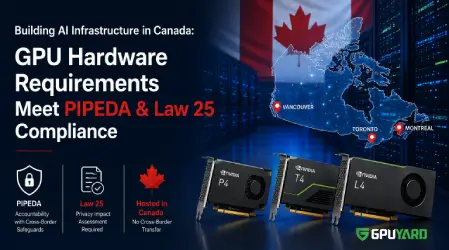
GPUYard runs bare-metal GPU dedicated servers in Montreal, Toronto, and Vancouver — physical Canadian data centers, not virtualized capacity routed through a Canadian region label. Every server is provisioned exclusively for one account: no shared tenants, no noisy neighbors.
The Canada lineup is built around the exact hardware that production teams actually need: NVIDIA L4 24GB Tensor Core, Tesla T4 16GB, and Tesla P4 8GB.
- Compliance: Physical Canadian facilities directly satisfy the PIPEDA accountability question and the Law 25 pre-transfer trigger — there's no cross-border transfer to document.
- Cost: Entry-level configurations (like the Intel Xeon with NVIDIA Tesla P4) start at just $133/month, against roughly $250–$690/month for a comparable cloud instance run continuously.
- Track record: Over 20 years in the hosting industry, 10,000+ clients served, and independently verified through Trustpilot, DMCA.com, WHTop, and ServerVerify.
Conclusion
A successful AI project in Canada depends on two things working together: hardware capable of cost-effectively serving the model, and infrastructure that doesn't create a legal liability while doing it.
Chasing the biggest, most expensive GPU when you only need inference wastes budget. Chasing compliance while under-provisioning hardware creates a pipeline that can't keep up.
A Canadian-based GPU server addresses both at once — enterprise-grade compute, physically located inside the jurisdiction your data protection obligations are built around.
If you're looking for high-performance, fully compliant dedicated AI infrastructure, explore our GPU Dedicated Servers in Canada starting at just $133/month.
Frequently Asked Questions (FAQ)
Ready to scale your AI workloads without the hyperscale price tag?
Explore GPUYard’s high-performance Dedicated GPU Servers and deploy your bare-metal H100, H200, or multi-GPU environments today.
 Recent Topics for you