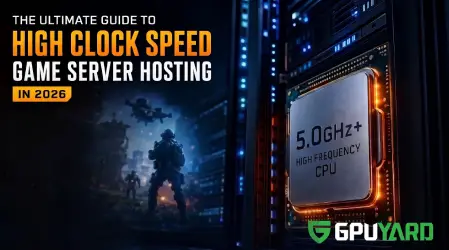
As we navigate the demands of multiplayer gaming in 2026, the underlying server infrastructure has fundamentally shifted. With Unreal Engine 5 pushing massive, highly detailed environments and complex AI behaviors to the server side, the conventional "high core-count" enterprise approach is officially obsolete for high-performance game hosting.
For infrastructure architects and studio DevOps teams, the mandate is clear: single-thread performance dictates gameplay quality.
Quick Summary: Why Hardware Matters in 2026
- Single-Thread Dominance: Game loops run sequentially; GHz matters more than core count.
- Tick Rate Budgets: 128Hz gaming allows only 7.8ms for all CPU calculations.
- Bare Metal > Cloud: Standard VMs introduce "noisy neighbor" latency that ruins competitive integrity.
1. The Core Count Myth in Game Server Hosting
In traditional web hosting, maximizing core count is the standard. However, game servers operate on a sequential logic model. The "main game loop"—which validates player movement and calculates hit registration—cannot be easily split across 64 different cores.
- The Bottleneck: Event B relies on the outcome of Event A.
- The Reality: A 128-core processor at 2.5GHz will perform significantly worse than an 8-core processor running at 5.2GHz.
While multiple cores allow you to host more individual matches, the performance ceiling of a single competitive match is dictated entirely by single-core frequency.
2. Infrastructure Comparison: Cloud vs. Bare Metal
To understand why standard virtualization fails, look at the technical overhead comparison:
| Feature | Standard Cloud VM (AWS/GCP) | GPUYard High-Freq Bare Metal |
|---|---|---|
| CPU Clock Speed | 2.5GHz - 3.2GHz (Shared) | 5.0GHz+ (Dedicated) |
| Processing Path | Virtualization Layer (Hypervisor) | Direct Hardware Access |
| Performance | Variable (Noisy Neighbors) | Deterministic & Consistent |
| 128Hz Stability | Frequent "Dropped Ticks" | Guaranteed Stability |
3. Esport Standards: 128Hz Tick Rates and Millisecond Budgets
In 2026, the "tick rate" is the definitive metric of server quality. A 128Hz tick rate means the server updates the game state 128 times every second.
- The 7.8ms Window: At 128Hz, the CPU has exactly 7.8 milliseconds to process player inputs, physics, and networking for every frame.
- The Consequence: If the CPU lacks the raw frequency to finish within that window, the server "drops ticks," leading to "ghost bullets," stuttering, and player frustration.
High clock-speed processors ensure the compute time remains well under the frame budget, guaranteeing the zero-lag environment required for professional esports.
4. Handling UE5 Server-Authoritative Physics and AI
Modern game design has moved to strictly server-authoritative architectures to eliminate cheating. This places a massive computational load on the CPU:
- Dynamic Environments: When a building collapses in a match, the server CPU computes the debris physics for all 100+ players simultaneously.
- Next-Gen AI: Highly complex, AI-driven NPCs use pathfinding algorithms that consume massive CPU cycles per tick.
Standard enterprise processors choke under these simultaneous calculations. High-frequency CPUs power through these workloads, maintaining a perfectly synchronized experience.
5. Why Standard Cloud VMs Fail Modern Games
Standard cloud instances are optimized for enterprise scalability, not low-latency gaming. They utilize high-core-count processors with lower clock speeds to maximize client density. For a game studio, this is an infrastructure liability.
Bare Metal provides direct access to the silicon, allowing for sustained boost clocks of 5.0GHz+ without the "jitter" introduced by a virtualization layer.
Frequently Asked Questions (FAQ)
Ready to deploy?
At GPUYard, we provide elite, high-frequency bare-metal servers engineered for the 2026 gaming landscape. Bypass the limitations of the cloud and secure the raw processing power your game deserves.
 Recent Topics for you