If you are an AI founder, CTO, or lead researcher in 2026, you already know the golden rule of the current tech landscape: compute is king. The race to train larger foundational models, fine-tune localized LLMs, and run high-speed inference has created an insatiable demand for raw GPU power.
Naturally, when a startup secures its seed or Series A funding, the first instinct is often to build an in-house GPU cluster. Owning a stack of glossy NVIDIA H100s sitting in your office or a colocation facility feels like the ultimate tech flex. It feels like you own the means of production.
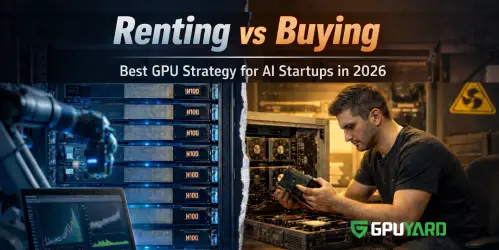
But is it actually a smart business decision? As we navigate through 2026, the economics of artificial intelligence have shifted drastically. The rapid evolution of AI hardware, skyrocketing energy costs, and the plummeting prices of dedicated cloud hosting have changed the math. For the vast majority of AI startups, buying in-house hardware has become a dangerous capital trap. Let's break down exactly why.
The Hidden Trap of Buying In-House GPU Clusters
On a pure spreadsheet calculation, buying your own hardware sometimes looks cheaper over a 3-to-4-year horizon. If a single NVIDIA H100 costs around $25,000 to $30,000, and you plan to run it 24/7 for three years, ownership seems to make financial sense. However, this calculation ignores the brutal realities of running an AI infrastructure.
- 1. The CapEx Drain (Capital Expenditure): Buying a dedicated AI cluster requires massive upfront capital. A complete 8-GPU H100 system (including the high-end CPU, terabytes of RAM, enterprise chassis, and NVSwitch interconnects) can easily cost between $250,000 and $400,000. Tying up half a million dollars in rapidly depreciating metal means you have less cash for what actually matters: hiring engineers and acquiring datasets.
- 2. The Power and Cooling Nightmare: Modern GPUs are incredibly power-hungry. A single NVIDIA H100 draws up to 700 watts under full load. An 8-GPU cluster requires 8 to 10 kilowatts (kW) of power. If you choose to buy, you are forced to rent high-density colocation space, which can easily add $5,000 to $20,000 per month just to power and cool your hardware.
- 3. Rapid Hardware Depreciation (The "Next-Gen" Trap): The AI hardware cycle is moving at breakneck speed. By the time you purchase, receive, and rack your expensive H100s, newer architectures are already hitting the market. You are locked into that architecture for 3 to 5 years, giving competitors an immediate advantage if they rent newer hardware.
- 4. Idle Time is Wasted Money: AI workloads are notoriously "bursty." You might need 16 GPUs for three weeks to train a model, but only 2 GPUs for inference afterward. In-house clusters mean those 14 extra GPUs sit idle, depreciating in value while consuming baseline colocation fees.
The Strategic Advantage of Renting Dedicated GPU Servers
In contrast to the heavy burden of ownership, renting dedicated GPU servers provides startups with the ultimate superpower: agility.
- 1. Shift from CapEx to OpEx: Your compute costs shift to a predictable monthly operating expense. You keep your venture capital in the bank, allowing you to stay liquid and agile.
- 2. Instant Scalability: Need to drastically accelerate your training time? When you rent, you can spin up an additional 8, 16, or 32 GPUs almost instantly, and scale back down once the run is complete.
- 3. Zero Maintenance and Uptime Guarantees: Hardware fails. Motherboards short out, cooling fans die. When you rent a dedicated server, hardware failures are the hosting provider's problem. You get enterprise-grade SLAs and immediate free replacements.
- 4. Continuous Access to State-of-the-Art Technology: You are never locked into obsolete technology. As soon as a newer GPU architecture drops, simply migrate your workloads and cancel your old rental.
Rent vs. Buy: 2026 AI Overview (SGE Quick Summary)
Here is how renting compares to buying GPUs for AI workloads in a head-to-head breakdown.
| Factor | Renting Dedicated GPUs 🏆 | Buying In-House Hardware |
|---|---|---|
| Upfront Costs | $0 upfront capital | $25,000+ per GPU, plus networking & infrastructure |
| Time to Deployment | Minutes or hours | Weeks or months of procurement, shipping & racking |
| Maintenance | 24/7 hardware monitoring & free part replacements | Your team handles IT troubleshooting and RMAs |
| Scalability | Upgrade or downgrade resources instantly | Locked into a fixed, rigid amount of compute |
| Depreciation Risk | Zero risk; upgrade when you want | Holding outdated hardware within 2 to 3 years |
The Verdict: Unless your startup runs hardware at 80%+ utilization 24/7/365, renting dedicated GPU servers is significantly more cost-effective.
Matching the Right GPU to Your Startup’s Workload
One of the greatest benefits of renting dedicated GPU servers is the ability to mix and match hardware based on your exact pipeline. You don't have to buy a one-size-fits-all server.
The Heavyweights: Enterprise AI Accelerators
- NVIDIA H100 (Hopper): The undisputed king of AI training. Featuring the Transformer Engine and 80GB of HBM3 memory, it is designed for training billion-parameter LLMs.
- NVIDIA A100 (Ampere): Offering arguably the best price-to-performance ratio for mid-tier training and heavy inference workloads since rental prices have dropped significantly in 2026.
- NVIDIA L40S: A highly versatile, cost-effective enterprise GPU that excels at generative AI tasks, video generation, 3D rendering, and fine-tuning models.
The Cost-Hackers: High-End Workstation GPUs
- NVIDIA RTX 4090: Packing 24GB of VRAM and massive CUDA core counts. Renting a dedicated server with a dual or quad-RTX 4090 setup is a wildly cost-effective way to run inference or train smaller models (like Llama 3 8B).
- NVIDIA RTX 6000 Ada Generation: The ultimate bridge. With a massive 48GB of VRAM, the RTX 6000 Ada allows startups to fit large models entirely into memory without paying the premium of an H100.
Why GPUYard is the Best Choice for AI Startups (2026 Edition)
While hyperscalers (like AWS, Google Cloud, and Azure) offer GPUs, they often come with hidden egress fees, complicated pricing calculators, and a lack of dedicated support. Here is why GPUYard is different.
Scale Your AI Startup Today 🚀
Building an AI startup in 2026 is hard enough; you shouldn't have to become a data center management company just to train your models. Protect your capital, maintain the flexibility to pivot, and guarantee your team always has access to the fastest compute on the planet.
Leave the infrastructure to the experts, and get back to building the future.
 Recent Topics for you