Scaling an artificial intelligence workload from a research sandbox into a production environment breaks traditional IT infrastructure.
When you transition from prototyping a Large Language Model (LLM) to serving it continuously to thousands of users, the bottlenecks shift. The challenge is no longer just writing efficient PyTorch code. The friction points become hardware procurement, thermal throttling, virtualization overhead, and strict data sovereignty laws.
To run generative AI and deep learning pipelines profitably in 2026, organizations must bypass legacy data center designs. You need direct access to silicon, granular resource orchestration, and a facility physically capable of powering it all.
What is Enterprise-Grade AI Infrastructure?
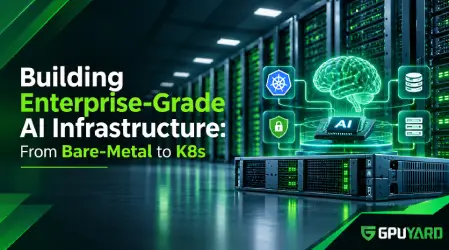
Enterprise-grade AI infrastructure is a specialized, single-tenant computing environment designed to train and serve artificial intelligence models without performance degradation or data privacy risks. It relies on bare-metal dedicated GPU servers to eliminate hypervisor overhead, utilizes advanced thermal management (like direct-to-chip liquid cooling) to handle 600W+ processors, and is orchestrated via bare-metal Kubernetes (K8s) to automate workload distribution. This architecture ensures maximum PCIe bandwidth, hardware-level isolation, and absolute data sovereignty.
Here is the blueprint for architecting a production-ready AI infrastructure stack, from the physical hardware layer up to strict Zero-Trust compliance.
Step 1: The Compute Strategy (Agility Over Ownership)
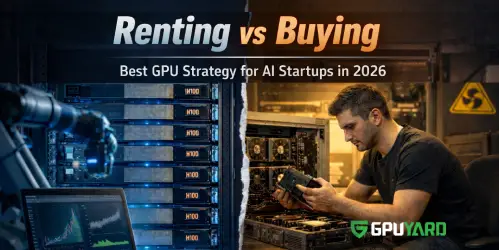
The instinct for many well-funded startups and enterprise CTOs is to purchase hardware outright. Owning a cluster of NVIDIA H100s feels like a strategic moat. Financially, it is often a trap.
AI silicon iterates at a blistering pace. Tying up hundreds of thousands of dollars in Capital Expenditure (CapEx) locks your organization into hardware that depreciates rapidly. Furthermore, the baseline utilization of AI workloads is notoriously bursty—you require massive compute for three weeks of training, followed by months of lightweight inference.
Shifting to an Operating Expense (OpEx) model by renting dedicated bare-metal servers allows you to scale instantly, swap architectures when newer silicon drops, and right-size your hardware to the specific pipeline. You do not always need an H100; enterprise inference workloads run incredibly efficiently on NVIDIA L4 or Tesla T4 architectures.
🔗 Deep Dive: Explore the raw financial math and right-sizing strategies in our guide: Why Renting GPU Dedicated Servers Beats Buying In-House Hardware for AI Startups.
Step 2: Surviving the 600W Thermal Wall
Procuring the hardware is only the first hurdle. Powering and cooling it is where legacy on-premise infrastructure fails.
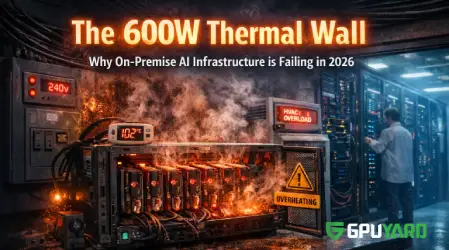
We are firmly in the 600W era. A single modern NVIDIA accelerator demands up to 600 watts of Thermal Design Power (TDP). A standard 8-GPU server node pulls 4.8kW to 6kW continuously. Traditional corporate HVAC systems and older 10kW-per-rack data centers simply cannot displace this volume of heat.
When ambient temperatures spike, silicon initiates self-preservation protocols. This is known as thermal throttling. Your expensive GPU lowers its clock speed to prevent physical melting, drastically increasing your AI inference latency. To extract 100% of the compute you pay for, you must host your hardware in purpose-built, high-density facilities.
🔗 Deep Dive: Understand the physics of localized hot spots and throttling in our analysis: The 600W Thermal Wall: Why On-Premise AI Infrastructure is Failing.
Step 3: The Orchestration Layer — Bare-Metal Kubernetes
Once the physical hardware and cooling are secured, you must connect the compute to your applications.
Standard cloud environments run on virtual machines. Virtualization introduces a hypervisor layer between your operating system and the physical hardware. For standard web hosting, this overhead is negligible. For AI, it is unacceptable. Hypervisors restrict PCIe bandwidth and introduce latency between the CPU and the GPU.
The industry standard for maximum performance is Bare-Metal Kubernetes. By deploying K8s directly on the host OS and bridging it with the NVIDIA Container Toolkit, your containerized AI workloads gain unthrottled, direct access to the GPU.
🔗 Deep Dive: Get the exact terminal commands and configuration files to build your cluster in our technical walkthrough: How to Configure Bare-Metal Kubernetes for GPU Orchestration.
Step 4: Resource Maximization with MIG
Most organizations severely underutilize their dedicated servers. If you assign a lightweight 7B-parameter inference endpoint to a full 80GB NVIDIA A100 or H100, the vast majority of the silicon’s Streaming Multiprocessors (SMs) will sit idle.
NVIDIA’s Multi-Instance GPU (MIG) technology solves this at the hardware level. MIG allows you to partition a single physical GPU into up to seven fully isolated instances. Each instance operates with its own dedicated memory, cache, and compute cores. This is not time-slicing; a heavy workload on one partition cannot starve or interrupt a workload on another.
MIG allows an enterprise to run multiple isolated models—such as a chatbot, a document embedding job, and a video analytics pipeline—concurrently on a single card without resource contention.
🔗 Deep Dive: Learn how to execute the
nvidia-smicommands to isolate workloads in our Multi-Instance GPU (MIG) Partitioning Tutorial for A100/H100.
Step 5: Sovereign AI, Security, and Compliance
Generative AI introduces severe data privacy liabilities. If your model processes financial records, patient data, or proprietary corporate IP, deploying on multi-tenant public cloud infrastructure introduces unacceptable risk.
This reality has given rise to Sovereign AI—infrastructure built, trained, and executed on highly sensitive data that must remain within strict physical and digital borders.
Achieving Sovereign AI requires two things:
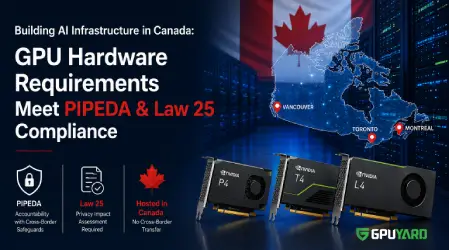
- Jurisdictional Compliance (Data Residency): In regions like Canada, regulations such as PIPEDA and Quebec's Law 25 require strict accountability and documented impact assessments before personal data crosses a border. Utilizing physical, single-tenant servers within the target country bypasses cross-border legal liabilities entirely.
- Zero-Trust Architecture: Perimeter firewalls are insufficient. You must secure the cluster from the hardware firmware layer (Secure Boot, TPM) up through network micro-segmentation.
🔗 Deep Dive (Compliance): See how hardware selection and data residency intersect in our guide to Building AI Infrastructure in Canada: PIPEDA & Law 25 Compliance.
🔗 Technical Tutorial (Zero-Trust): Learn how to secure the hardware firmware layer and configure Kubernetes micro-segmentation in our step-by-step guide: Setting up Zero-Trust Security for Sovereign AI Workloads on GPU Clusters.
Build Your Enterprise AI Foundation with GPUYard
Building an AI startup or an enterprise internal tool is difficult enough; your engineering team should not have to become data center thermal experts or hardware procurement specialists just to train a model. GPUYard provides the ultimate foundation for Sovereign AI and high-performance inference. We deliver bare-metal, single-tenant NVIDIA dedicated servers housed in state-of-the-art facilities engineered to shatter the 600W thermal wall.
 Recent Topics for you